There’s often confusion about what makes a Savannah cat “good quality” and what the F (filial generation) number — such as F1, F2, F3, F4, etc. — actually means. Let’s clear up some common misconceptions and explain what truly defines a Savannah cat: quality and breed type, not just the generation number.
Hybrid Generations: F1, F2, and F3
These early generations are considered hybrids because they are closest to the wild ancestor — the African Serval.
• F1 Savannahs have a Serval parent.
• F2 Savannahs have a Serval grandparent.
• F3 Savannahs have a Serval great-grandparent.
Because of that close Serval ancestry, F1–F3 Savannahs often display some Serval-like behaviors — such as being more independent, territorial, determined, highly active, or cautious with new people and environments.
They can be incredibly intelligent and loyal, but they typically do best with experienced owners who can provide space, enrichment, and an understanding of their hybrid nature.
Males in these generations are always infertile, so they are not bred forward directly. Instead, the purpose of F1–F3 female Savannahs is to be Foundation Savannahs bred down to SBT levels, helping develop the breed by introducing Serval genetics early on and refining them over several generations.
Each step down brings the cats closer to the consistent, domestic Savannah breed standard we continue to work toward today.
SBT Generations: F4 and Later
Starting with F4, Savannahs can be considered SBT (Stud Book Traditional) — meaning they are purebred Savannahs, not hybrids in the TICA Registry. SBT’s are when Savannahs have only been bred to other Savannahs for at least 3 generations prior. Those Savannahs are fully domestic and more consistent in temperament and breed type. This includes F4, F5, F6, F8, F10, or even F20 — all SBTs, as long as only Savannahs appear in their ancestry for at least three generations.
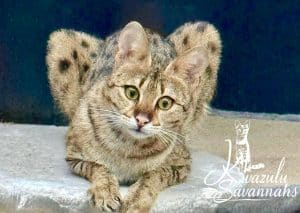
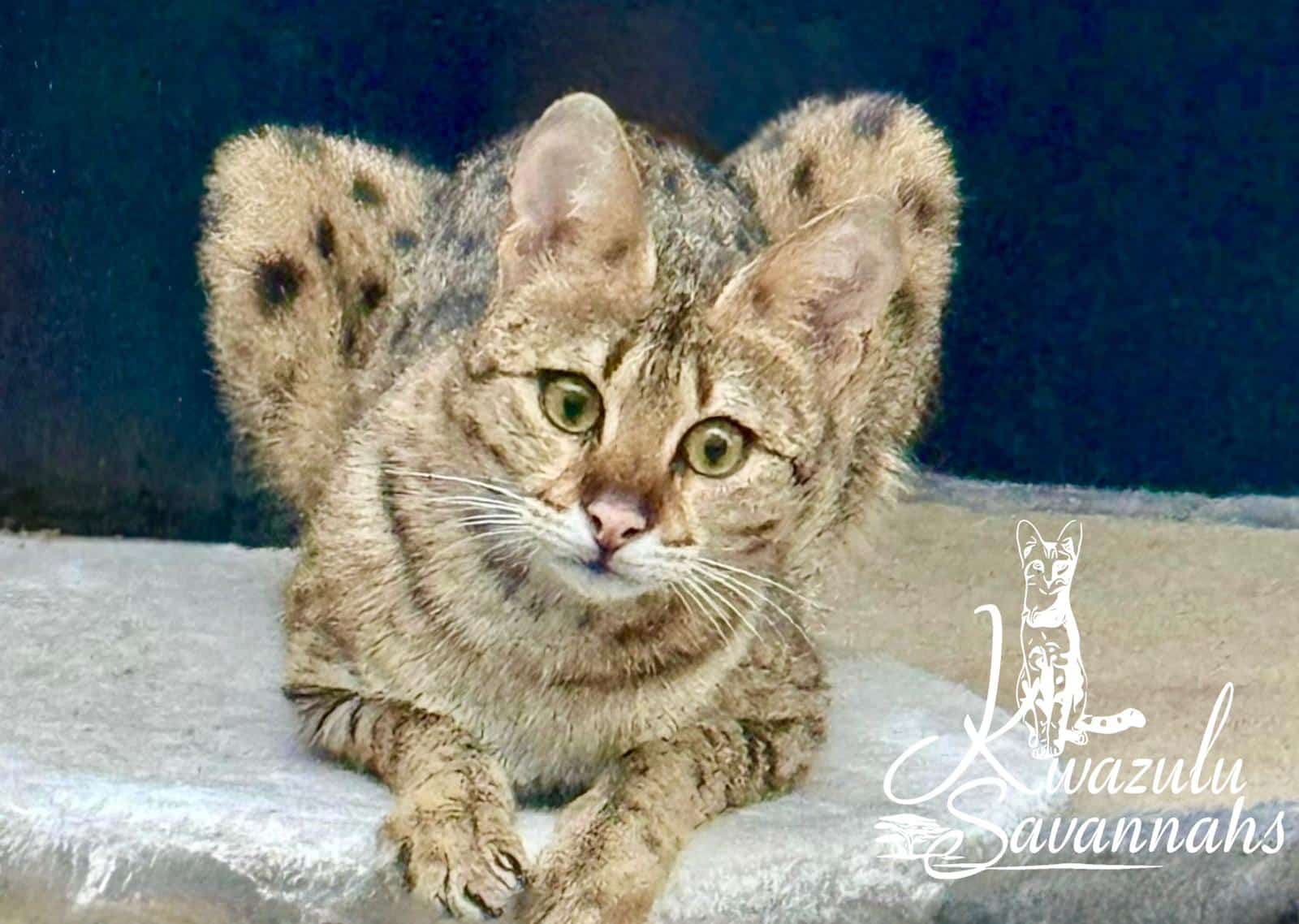
These later-generation Savannahs should maintain the same graceful, athletic look and the distinct appearance that defines what a Savannah is meant to look like — long legs, tall ears, elegant body lines, and bold spotting — but in a domestic cat package. They are more predictable in temperament — typically affectionate, social, playful, and puppy-like in behavior, often forming strong bonds with their families and even learning to walk on a leash or play fetch. They retain the true Savannah look while being easier to live with day-to-day. In actuality that is the end goal of the Savannah breed.
At this point, the F (filial generation) number mainly serves as a breeding reference, especially for tracking male fertility. Fertility can occasionally appear in F4 males (though this is rare) and becomes increasingly consistent from F5 onward, stabilizing in the F6, F7, F8, and later generations.
Quality vs. Generation
A common misconception is that a cat’s generation determines how “good” or “typey” it looks. In reality, it’s breeding quality — not the F-number — that determines how much a cat resembles the correct Savannah type. When you see a Savannah that doesn’t quite look like what a Savannah is meant to look like — perhaps more like a regular domestic or another spotted breed — it’s not because it’s a later generation. It’s usually due to poor breeding quality. That can happen when pairings are accidental, experimental, or not chosen with strong breed type in mind.
Breeding for Type and Improvement
When breeders focus on type, carefully keeping back only the best cats and using selective breeding, each later generation actually becomes better. By using selective, quality pairings, breeders reinforce and solidify the breed’s hallmark features — tall, elegant bodies, long necks, large ears, bold spotting, and graceful movement.
Generation numbers don’t create that distinctive look — selective, thoughtful breeding does.
What About Size?
Another common myth is that later generations are smaller. Except for F1–F2 (which can be quite large due to Serval influence), size naturally varies across all other generations. Even two F4s from the same litter can differ greatly — one may be petite, another robust. There’s no guaranteed pattern for physical size. The size of a Savannah should also never be judged by weight as it is not a true indicator of size due to their taller, lankier builds. A higher weight can sometimes signal obesity rather than size, and maintaining a lean, athletic build is always healthier for Savannahs and all cats alike.
Savannah enthusiasts value the breed for their intelligence, grace, and personality, not just their size. The true Savannah appeal lies in their balance of elegance, athleticism, and temperament.
In Summary
• F1–F3 = Hybrid Savannahs or Foundation Savannahs, closest to the Serval and used to establish the breed.
• They can show more Serval-like behaviors and are best suited for experienced homes.
• Their purpose is to be bred down to SBT generations to help build the pure Savannah line.
• F4 and later (if only Savannah’s have been used) = SBT Savannahs, purebred, domestic, and family-friendly, with consistent type and temperament.
• F (filial) numbers mainly track fertility — not quality or appearance.
• Quality breeding is what makes a Savannah truly look, move, and act like a Savannah.
The generation number is simply a breeding tool — it is quality, structure, temperament, and selective breeding that shape the Savannah cat we are striving for as the breed continues to develop and improve.
At the end of the day, whether you’re a breeder or a buyer, remember this:
When looking for a Savannah cat, look at the cat itself — its breed type, health, personality, and temperament.
Focus on finding the right fit for your home and lifestyle, not just the F-number. Too often, people get caught up in generation labels and overlook what truly matters — a well-bred, healthy, and happy Savannah with the right temperament for you.